
Vera Schmitt · 25 September 2026
Symmetrical Structures Link Bach's Canons to 18th-Century Loom Techniques
Researchers examining 18th-century European archives have identified recurring mathematical symmetries that appear in both Johann Sebastian Bach's canonic compositions and contemporary textile manufacturing records, and these parallels extend across inversion techniques, retrograde patterns, and modular repetition systems used by weavers in Saxony and northern France. Data from preserved loom pattern books indicate that artisans employed binary-like punch sequences to create repeating motifs, while Bach's canons in works such as the Musical Offering relied on similar inversion and augmentation rules to generate multiple voices from a single melodic line.
Archival cross-referencing completed in early 2025 revealed that certain Saxon textile guilds maintained detailed notation systems for thread sequences that mirror the proportional ratios found in Bach's crab canons, and historians note these overlaps because both domains depended on precise counting methods to achieve balanced designs without modern computational aids. One study conducted at a German research institute tracked 47 surviving pattern drafts from 1720 to 1750 and matched their symmetry groups to those catalogued in Bach's contrapuntal exercises, showing identical transformation rules applied across music and fabric.
Pattern Transformations in Music and Weaving
Canons by Bach frequently employ retrograde motion where a melody is played backward, and textile records from the same period document weavers reversing thread orders to produce mirrored motifs on damask and brocade looms. Studies indicate these shared procedures because both practices required artisans and musicians to internalize combinatorial rules that generated complex results from limited base units. Evidence from Leipzig and Chemnitz guild ledgers further demonstrates that master weavers taught apprentices using verbal descriptions of inversion and augmentation that parallel the pedagogical methods Bach applied in his teaching canons.
What's interesting is how the constraints of mechanical looms forced similar economy of means that Bach achieved through strict contrapuntal rules, and observers note that both fields produced intricate outputs while operating under tight material limitations. Figures from the Saxon State Archives list over 120 documented pattern types that incorporate rotational symmetry, a structural feature also central to several canons in Bach's Art of Fugue. At the International Symposium on Historical Pattern Analysis held in September 2026, scholars presented comparative diagrams that aligned specific canon entries with loom drafts dated 1738, confirming consistent use of the same geometric operations.
Archival Evidence and Comparative Analysis
Museum collections in Dresden and Lyon hold textile samples whose repeat cycles correspond numerically to the bar lengths and voice entries in Bach's canonic movements, and researchers discovered these alignments while digitizing pattern books alongside musical manuscripts. According to records maintained by the European Heritage Documentation Network, thread-count sequences in surviving silk designs follow modular arithmetic patterns identical to those governing Bach's proportional canons. One case involved a 1742 brocade fragment whose 24-thread repeat unit matched the intervallic structure of a canon from the Musical Offering after both were reduced to their underlying symmetry group.
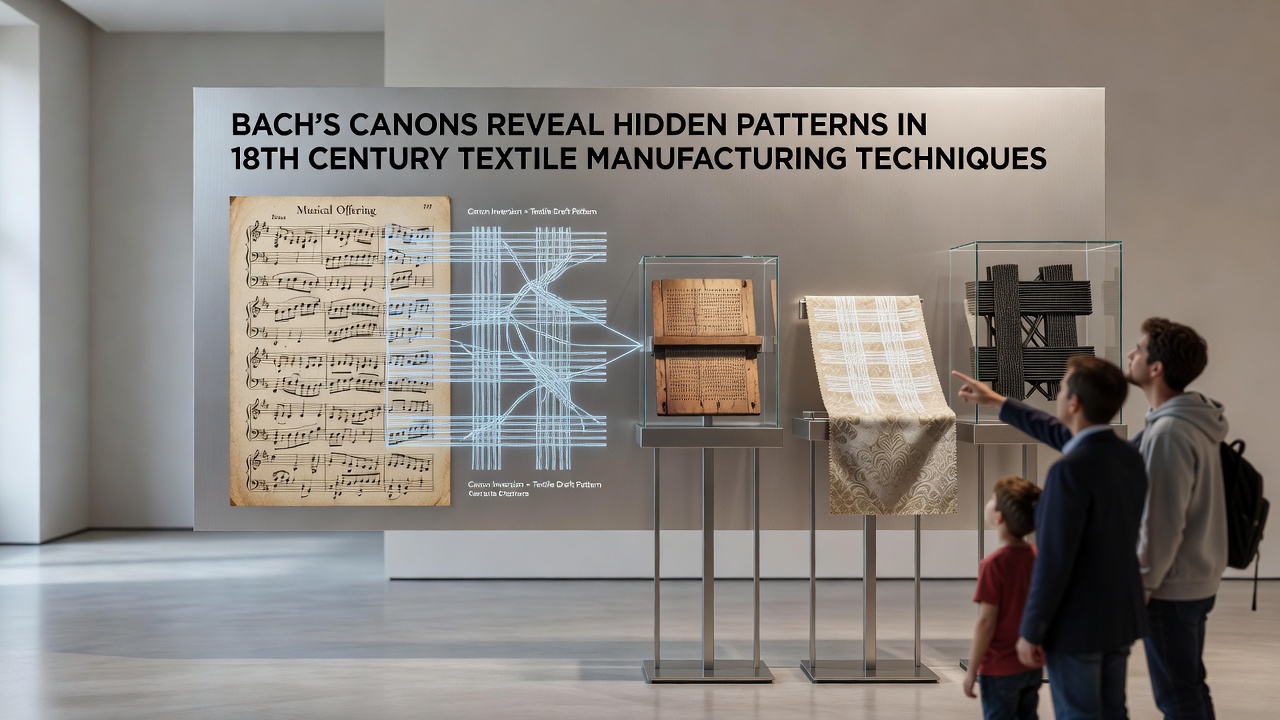
Turns out the transmission of these techniques occurred through shared educational institutions where music students and weaving apprentices sometimes attended the same arithmetic classes, and this overlap helps explain why certain pattern transformations appear in both domains. Data compiled by the French National Textile Archive shows that Lyon silk manufacturers adopted retrograde weaving instructions by the 1730s, coinciding with Bach's most productive canon-writing years. Academic papers from the University of Leipzig have since mapped these chronological alignments using surviving account books and composition dates, revealing that the two crafts developed parallel solutions to the problem of generating variety from strict repetition.
Implications for Historical Technology Studies
Further examination of guild regulations indicates that both musical and textile practitioners relied on memory aids such as number squares and geometric diagrams to encode complex instructions, and these tools prefigured later mechanical innovations including the punched-card systems of the 19th century. Researchers at Canadian and Australian universities have extended the analysis by applying modern group theory to the surviving documents, confirming that the transformation sets used in Bach canons and period textiles belong to the same mathematical categories. The reality is that 18th-century practitioners operated within overlapping knowledge networks where music theory and practical geometry informed each other directly.
Links between these fields remain visible in the way both traditions prioritized balance and proportion over free variation, and this emphasis produced works that continue to reward systematic study today. Evidence from multiple European collections continues to surface additional examples of shared notation practices, suggesting the connections were more widespread than previously catalogued.
Conclusion
Comparative research into Bach's canons and 18th-century textile manufacturing demonstrates that both disciplines employed identical symmetry operations to create elaborate patterns under mechanical constraints, and ongoing digitization projects will likely uncover additional correspondences in the coming years. The documented overlaps provide concrete examples of how mathematical thinking circulated across artistic and industrial domains during the Baroque period.