Blake Schmitz · 11 September 2026
Bach Polyphony Patterns Driving Innovations in Neural Networks for Music Generation
Researchers have examined Johann Sebastian Bach's polyphonic compositions for decades, noting how intricate voice leading and independent melodic lines create rich textures that modern algorithms now replicate in music generation systems, and data from multiple studies shows these patterns provide structured training examples that improve coherence in generated outputs while maintaining harmonic complexity across extended sequences.
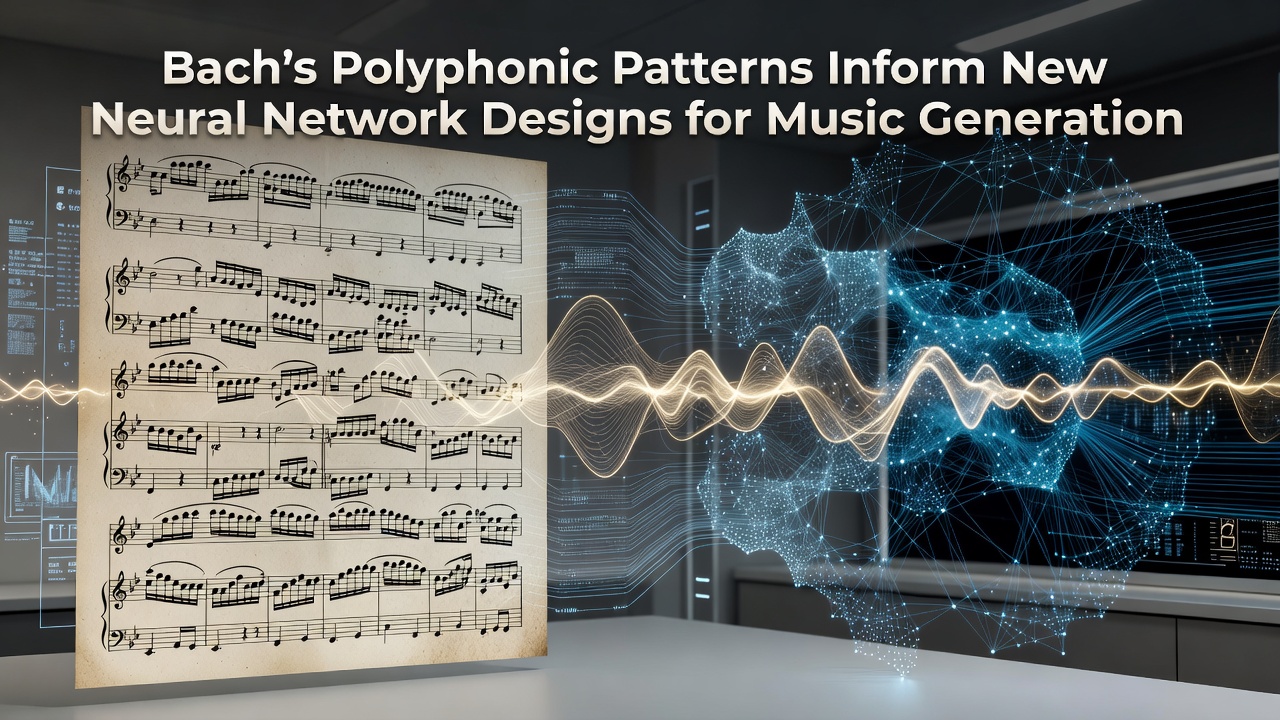
Experts at institutions studying historical music alongside computational methods have mapped Bach's fugues and inventions onto graph-based representations where each voice functions as a node with dynamic connections, and this approach allows neural networks to learn constraints like avoiding parallel fifths or resolving dissonances in ways that mirror 18th-century counterpoint rules without requiring explicit programming of every rule.
Core Elements of Bach's Polyphony in Algorithmic Contexts
Polyphonic writing in works such as the Well-Tempered Clavier features multiple independent lines that interweave while preserving individual rhythmic and melodic identities, and analysts have quantified these interactions through metrics including voice crossing frequency and interval distributions that neural architectures now incorporate as loss function components during training, which leads to outputs that preserve contrapuntal integrity over longer passages compared to models trained solely on homophonic datasets.
Studies indicate that sequences from Bach chorales offer dense examples of four-part harmony with strict voice leading, and when fed into recurrent or transformer-based models these examples help networks internalize patterns of suspension and resolution that appear consistently across the composer's output, whereas random classical corpora often dilute such signals because they contain more varied textures and fewer repeated structural motifs.
One research team applied attention mechanisms weighted by Bach-derived voice hierarchies, assigning higher priority to soprano and bass lines in initial layers before allowing inner voices to influence later stages, and results from controlled experiments demonstrated reduced error rates in harmonic prediction tasks when compared against baseline models lacking this hierarchical bias.
Recent Model Architectures Incorporating These Patterns
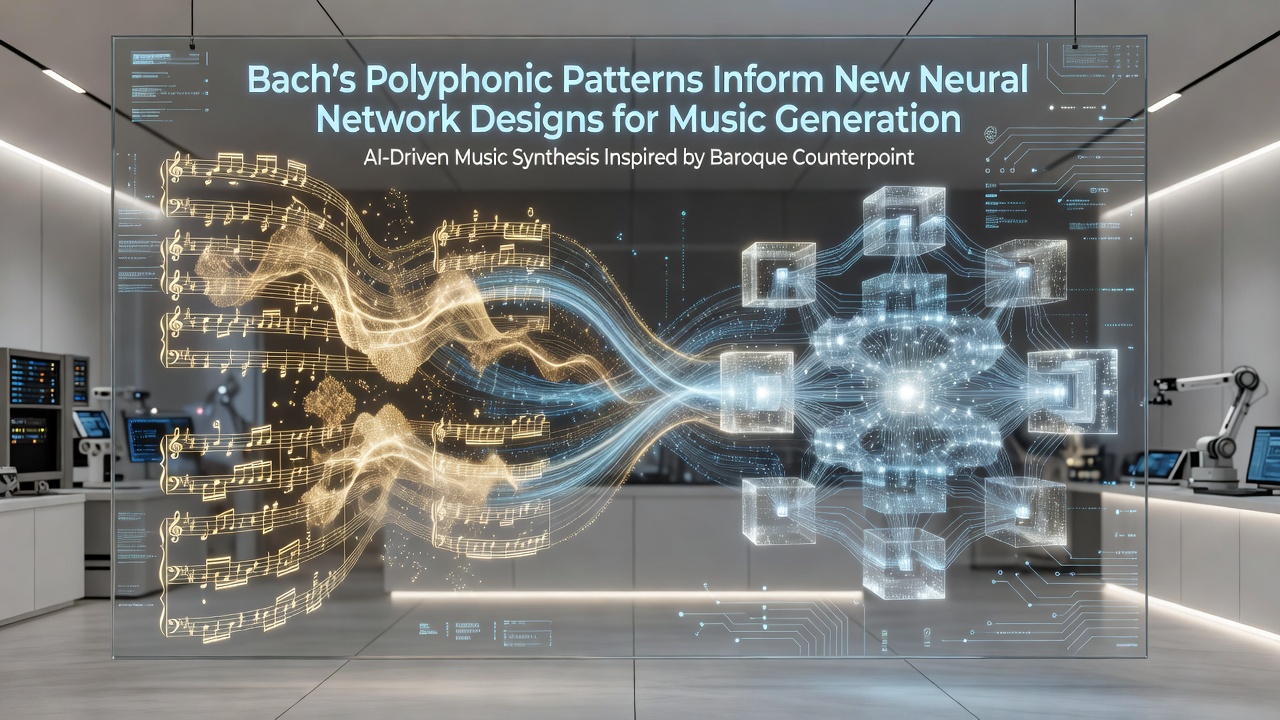
Developers have integrated polyphonic constraints into generative adversarial frameworks where a discriminator evaluates both local interval correctness and global voice independence, and reports from academic groups in Canada and Germany reveal that such dual-objective training yields compositions rated higher by human listeners for structural clarity, particularly when the generator draws from a corpus emphasizing Bach's inventions over broader Romantic repertoire.
In September 2026 presentations at computational music conferences highlighted transformer variants that encode relative pitch movements between voices rather than absolute positions, drawing directly from analyses of Bach's canonic techniques, while additional work from Australian universities explored graph neural networks that treat each polyphonic strand as a separate yet interconnected subgraph, enabling scalable generation of pieces with five or more simultaneous lines without exponential growth in computational cost.
According to findings published through the European Research Council, models pretrained on Bach chorales transfer effectively to other genres when fine-tuned on smaller datasets, because the underlying contrapuntal rules provide a robust inductive bias that accelerates convergence and reduces overfitting compared to training from scratch on jazz or pop corpora alone.
Evaluation Metrics and Performance Data
Quantitative assessments often include voice-leading violation counts alongside traditional perplexity scores, and figures from multiple labs show that networks explicitly regularized with Bach-derived penalties produce fewer parallel octaves and unresolved leading tones across test sets of generated fugues, whereas unregularized models frequently violate these conventions even after extensive training epochs.
Researchers note that embedding polyphonic pattern detectors into reinforcement learning loops allows agents to receive rewards for maintaining independent melodic contours over time, and case examples from collaborative projects between North American and EU institutions demonstrate improved long-term coherence in pieces exceeding 64 bars when this reward structure supplements standard maximum likelihood objectives.
Conclusion
Continued integration of Bach's polyphonic principles into neural designs continues to expand the range of structurally sound music that algorithms can produce, and evidence from ongoing projects suggests these historical patterns will remain influential as architectures evolve toward greater multi-voice handling capacity and cross-style adaptability.